
Best Pan Size for Chicken Stir Fry (10, 12, or 14 Inch?)
Best Pan Size for Chicken Stir Fry: 10, 12, or 14 Inches?
Choosing the best pan size for chicken stir fry can make a noticeable difference in how evenly your chicken and vegetables cook. A pan that is too small can crowd the ingredients, trap excess moisture, and make it harder to achieve nicely browned chicken. However, choosing an oversized pan that does not match your stovetop can create its own cooking problems.
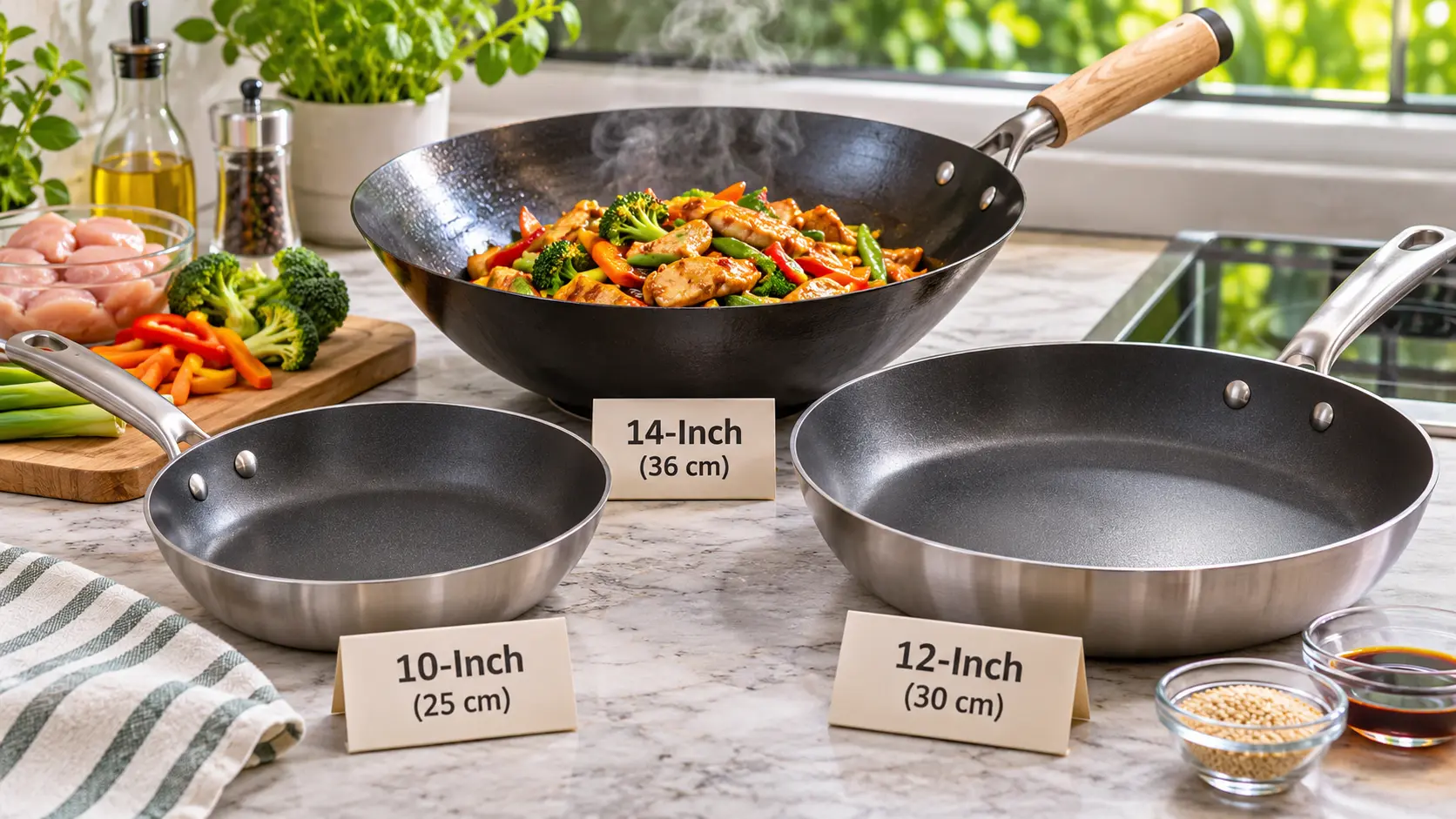
For most everyday home cooks, a 12-inch frying pan is a practical starting point for preparing chicken stir fry. A 10-inch pan can work for smaller portions, while a 14-inch wok or frying pan offers more room for larger meals when the burner can heat it effectively. The best choice ultimately depends on your serving size, the pan’s usable cooking surface, and your stovetop.
Quick Answer
A 12-inch frying pan is a versatile starting choice for many chicken stir fry meals at home. Choose a 10-inch pan for smaller portions, or consider a 14-inch wok or frying pan when preparing larger quantities. Before choosing, check the flat cooking surface rather than relying only on the advertised diameter, and make sure your stovetop can heat the pan properly.
Table of Contents
- What Is the Best Pan Size for Chicken Stir Fry?
- 10-Inch vs. 12-Inch vs. 14-Inch Pans for Chicken Stir Fry
- Wok vs. Frying Pan: Which Shape Works Better?
- How Pan Size Affects Chicken Browning and Cooking Performance
- Does Pan Material Matter When Choosing a Size?
- Choosing the Right Pan Size for Your Stovetop
- How to Choose the Right Pan Size for Your Cooking Needs
- Which Pan Size Should You Choose? Our Recommendations
- Frequently Asked Questions
- References
- Final Thoughts
What Is the Best Pan Size for Chicken Stir Fry?
The best pan size for chicken stir fry depends on how much food you prepare at once. A pan needs enough flat cooking space to spread the chicken pieces into a reasonably even layer, with room to move the ingredients while cooking. If you regularly prepare meals for two or more people, a 12-inch pan is a useful everyday starting point.
However, the advertised diameter alone does not tell you how much food a pan can comfortably handle. Two pans labeled 12 inches may have different flat-bottom widths, side slopes, and overall depths. These differences affect how much usable cooking space is available.
Best Pan Size for One or Two Servings
A 10-inch frying pan can be suitable when preparing a relatively small chicken stir fry portion. It is easier to handle, heats a smaller cooking area, and generally takes up less storage space than larger cookware.
This size can work well when cooking a modest amount of sliced chicken with a limited quantity of vegetables. However, if you add a large amount of broccoli, peppers, onions, or other ingredients, the available cooking surface can quickly become crowded.
A 12-inch pan provides additional room and gives you more flexibility if you occasionally prepare a larger meal or prefer to cook chicken and vegetables together.
Best Pan Size for Three or Four Servings
A 12-inch frying pan is a practical option for many households preparing chicken stir fry for several people. It offers more cooking space than a 10-inch pan without being as large or difficult to handle as some 14-inch cookware.
However, a 12-inch pan is not automatically large enough for every four-serving recipe. Thick chicken pieces, bulky vegetables, and sauces can take up considerable room. If the ingredients cannot fit without piling on top of one another, cooking in batches is usually a better approach.
Best Pan Size for Larger Family Portions
A 14-inch wok or frying pan may be more suitable when preparing larger portions regularly. The additional surface area can make it easier to separate ingredients, move chicken around, and cook multiple batches of vegetables.
However, a larger pan needs a suitable heat source. If your burner is too small or cannot provide sufficient heat, the outer areas of the pan may not heat as effectively as the center. This is particularly important when selecting a large wok for an ordinary home stovetop.
10-Inch vs. 12-Inch vs. 14-Inch Pans for Chicken Stir Fry
Comparing 10-inch, 12-inch, and 14-inch cookware makes it easier to understand how pan size affects everyday chicken stir fry preparation. Each size has advantages, but the best choice depends on your portion sizes, cooking equipment, and available storage space.
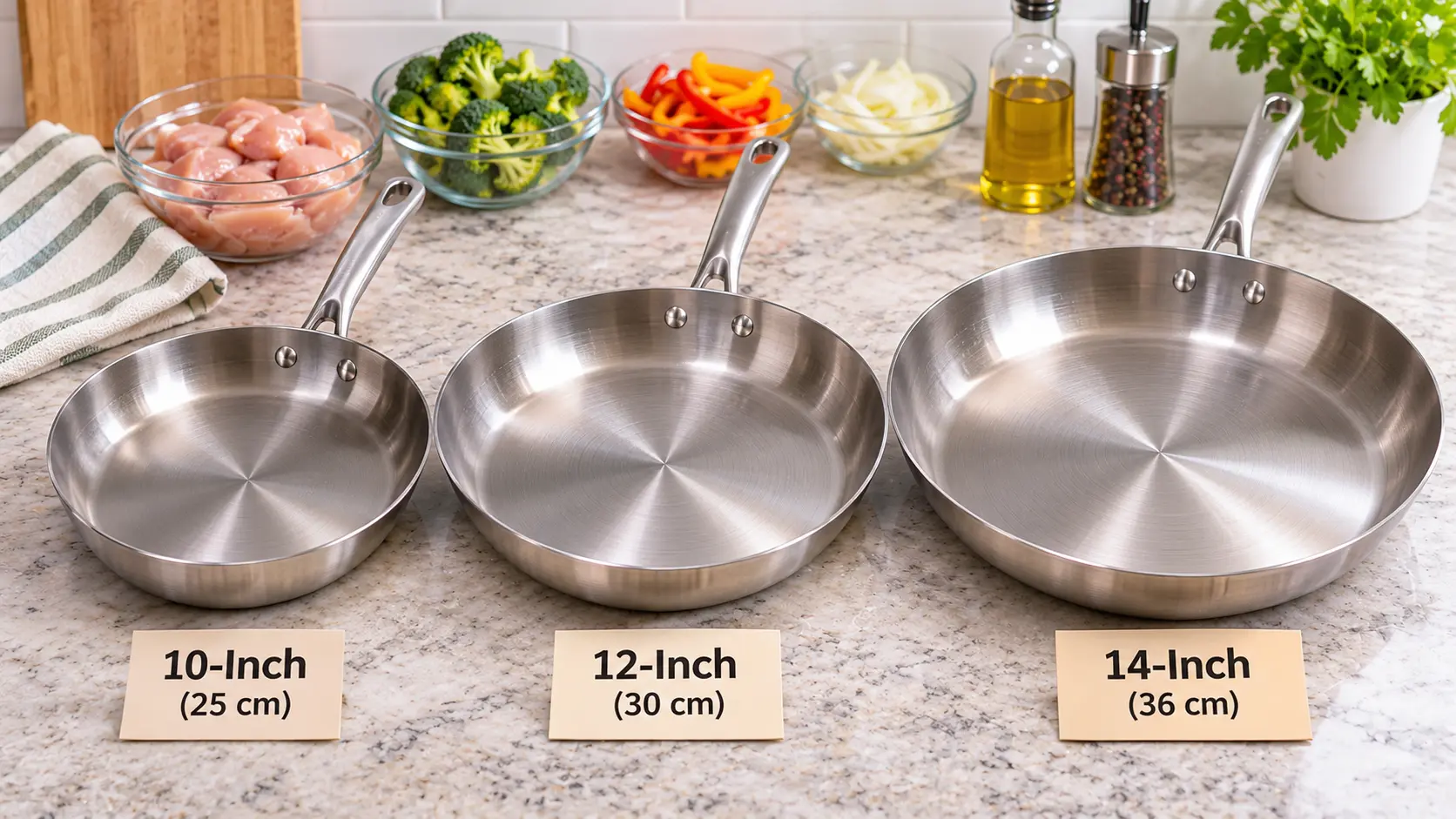
10-Inch Pan: Best for Small Portions
A 10-inch pan is a compact choice for smaller chicken stir fry meals. It is particularly useful for someone who cooks one portion at a time and does not need a large cooking surface.
Its smaller size can also make it easier to store in a kitchen with limited cabinet space. However, the limited cooking area means that adding chicken, vegetables, and other ingredients together may leave little room for stirring.
For this reason, a 10-inch pan is best suited to smaller meals rather than large family-style stir fries.
12-Inch Pan: A Practical Everyday Option
A 12-inch frying pan provides a useful balance between cooking capacity and everyday convenience. It offers more room for arranging chicken pieces than a smaller pan while remaining manageable for most home cooking tasks.
This size is especially practical for cooks who prepare different meals throughout the week. You can use it for chicken stir fry, sautéed vegetables, quick skillet meals, and other everyday dishes.
Its main limitation is that it may still become crowded when preparing large portions or combining several bulky ingredients. Cooking chicken in separate batches can help you get better results without immediately needing larger cookware.
14-Inch Pan or Wok: Best for Larger Portions
A 14-inch pan or wok provides a larger overall cooking area, making it attractive for people who regularly prepare meals for several family members.
A flat-bottom wok offers sloped sides that help contain ingredients while stirring and moving them around the pan. A large frying pan generally has a flatter cooking surface with more consistent contact across its base.
Although the larger size provides more room, it can also be heavier, harder to store, and less convenient on smaller burners. Check the manufacturer’s recommended burner compatibility before purchasing.
| Pan Size | Best Use | Main Advantage | Main Limitation |
|---|---|---|---|
| 10-inch | Small portions | Compact and easy to handle | Limited cooking space |
| 12-inch | Everyday home cooking | Versatile balance of size and convenience | May need batches for larger meals |
| 14-inch | Larger portions | More room for moving ingredients | Needs suitable burner space and heat output |
Why Advertised Diameter Is Not the Whole Story
One important detail when comparing cookware is the difference between the advertised diameter and the actual flat cooking surface. Manufacturers commonly describe pan size using the measurement across the top rim. This measurement does not necessarily represent the width of the flat base where most of the food makes direct contact with the pan.
For example, a 12-inch frying pan with a relatively wide flat base may provide a different cooking experience from a 12-inch wok with a narrower flat bottom and more sharply sloped sides.
Before buying, check the manufacturer’s specifications for:
- Top diameter: The measurement across the upper rim of the pan.
- Flat-bottom diameter: The width of the base that rests on the stovetop.
- Cooking surface: The practical area available for arranging and moving ingredients.
- Pan depth: The distance from the bottom to the upper rim.
Wok vs. Frying Pan: Which Shape Works Better for Chicken Stir Fry?
Pan shape matters almost as much as pan diameter when preparing chicken stir fry. A wok and a conventional frying pan can both produce good results, but they provide different cooking surfaces and handling characteristics.
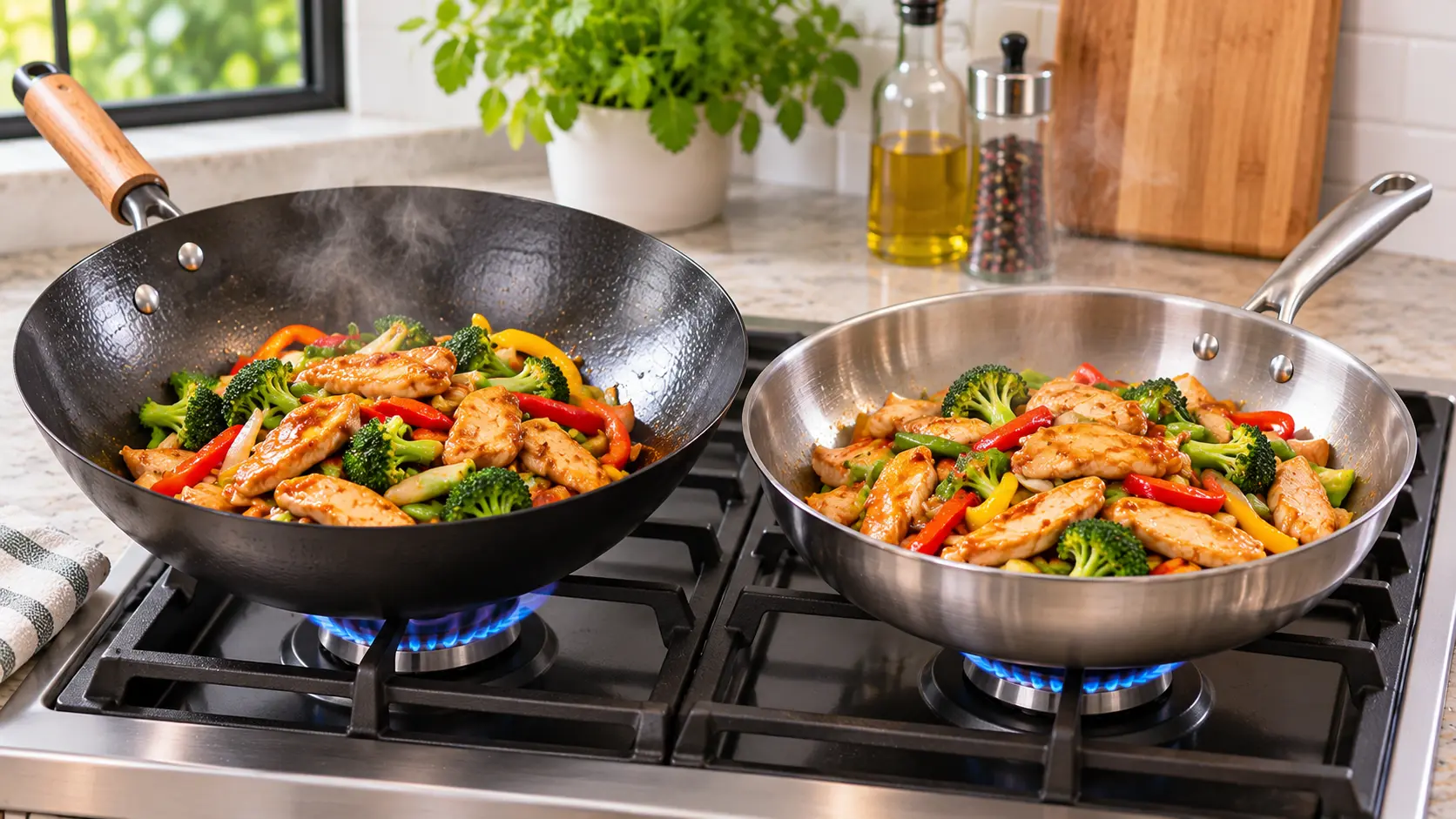
How a Wok’s Sloped Sides Affect Cooking
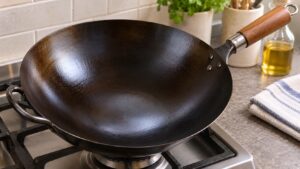
A traditional wok has a rounded or curved interior that becomes wider toward the top. This shape creates a concentrated cooking area near the bottom while providing sloped sides where ingredients can be moved during cooking.
A flat-bottom wok adapts this traditional shape for modern home stovetops. Its flat base provides contact with the cooking surface, while the sloped sides offer room for stirring, tossing, and temporarily moving ingredients away from the hottest central area.
This design can be useful when cooking chicken with several vegetables because the ingredients can be moved around the interior without easily spilling over the rim.
However, a wok’s sloped sides do not provide the same flat cooking area as a wide frying pan with an equivalent advertised diameter. If you prefer spreading chicken pieces across a broad flat surface, this difference is worth considering.
Why a Frying Pan’s Flat Surface Can Be Useful
A conventional frying pan generally has a broad, relatively flat cooking surface and lower or more gently sloped sides. This design makes it easier to spread chicken pieces into a single layer and maintain contact with the heated base.
For home cooks who primarily prepare chicken stir fry on electric or induction cooktops, a suitable flat-bottom frying pan can be a practical option. It is also familiar to people who already use a skillet for everyday cooking.
The main limitation is that a frying pan may have less interior depth than a wok. When stirring a large amount of chicken and vegetables, ingredients can sometimes move over the sides if the pan is too full.
Flat-Bottom Wok vs. Traditional Round-Bottom Wok
The choice between a flat-bottom and round-bottom wok depends largely on the stovetop.
A flat-bottom wok is generally easier to position on a conventional flat cooking surface. A traditional round-bottom wok is designed to sit in a wok ring or a suitable wok burner, depending on the equipment.
For most standard home electric and induction cooktops, a compatible flat-bottom design is the more practical choice. On gas stoves, both styles may be possible when the burner and manufacturer instructions support their use.
How Pan Size Affects Chicken Browning and Cooking Performance
The reason pan size matters is not simply that larger cookware can hold more ingredients. It also affects how much space the chicken has while cooking and how easily moisture can escape from the pan.
When too much chicken and vegetables are added to a small cooking surface, the ingredients can become crowded. Instead of developing a nicely browned exterior, the chicken may release moisture into the pan and cook in a wetter environment.
Why Overcrowding Causes Problems
Chicken pieces need enough room to make contact with the heated cooking surface. When they are packed tightly together, moisture released from the ingredients can accumulate. This can make browning more difficult and create a steamed or boiled texture rather than the seared surface many people want in a stir fry.
A larger pan can help by providing more space between ingredients. However, the improvement depends on whether the pan receives enough heat to maintain its cooking temperature after the food is added.
Simply moving from a 12-inch pan to a 14-inch pan will not automatically solve overcrowding if you fill the larger pan with proportionally more food.
How Cooking Surface Area Affects Moisture Evaporation
The available cooking surface influences how ingredients spread out and how much exposed area is available for moisture to evaporate. A crowded pan makes it harder to keep ingredients separated, especially when chicken, broccoli, peppers, and onions are cooked together.
For better results, avoid adding all the ingredients at once when the pan is already full. Give the chicken enough room to cook, remove it temporarily if necessary, and prepare the vegetables before combining everything with the sauce.
When to Cook Chicken in Batches
Batch cooking is a practical solution when your usual pan size cannot comfortably accommodate the entire recipe.
For example, if you are preparing chicken stir fry for a family using a 12-inch frying pan, divide the chicken into manageable portions rather than forcing all the pieces into the pan at once.
- Preheat the pan appropriately for its material and your stovetop.
- Add a manageable portion of chicken without covering the entire cooking surface.
- Cook the chicken until browned and safely cooked through, checking its internal temperature.
- Transfer the cooked chicken to a clean plate.
- Repeat with the remaining chicken if necessary.
- Cook the vegetables and combine them with the chicken and sauce.
Does Pan Material Matter When Choosing a Size?
Yes. Pan material can influence how cookware heats, retains heat, responds to temperature changes, and feels during everyday use. Even when two pans have the same advertised diameter, their materials and construction can make them behave differently during chicken stir fry preparation.
Carbon steel, stainless steel, and cast iron are three common cookware choices. Each has advantages and limitations, so the right option depends on your cooking habits, maintenance preferences, and stovetop.
Carbon Steel
Carbon steel is a popular material for traditional and modern woks. It is generally lighter than comparable cast iron cookware and is well suited to cooking techniques that involve frequent stirring and tossing.
Carbon steel cookware typically requires seasoning and appropriate care to maintain its cooking surface. Its performance also depends on thickness, construction, and how well the burner heats the pan.
For someone choosing a larger wok for chicken stir fry, carbon steel can be a practical option when easy handling and a traditional wok shape are priorities.
Stainless Steel
Stainless steel frying pans are popular for everyday cooking because they are durable, generally easy to maintain, and available in many sizes. Some stainless steel pans use layered construction with an aluminum or copper core to improve heat distribution.
When choosing a stainless steel pan, look beyond the advertised diameter. Check the construction, flat-bottom width, and whether the pan is designed for your stovetop.
A 12-inch stainless steel frying pan can be a versatile option for someone who wants cookware suitable for chicken stir fry as well as other everyday meals.
Cast Iron
Cast iron cookware is known for its substantial weight and ability to retain heat. It can be useful for browning food, but its weight can make a large pan more difficult to lift, shake, and maneuver during stir frying.
A large cast iron skillet may provide plenty of cooking space, but it does not necessarily offer the same handling experience as a lighter wok. This is worth considering if your cooking method involves frequently moving ingredients around the pan.
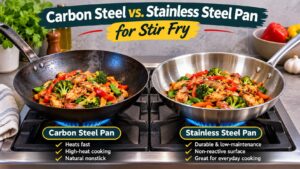
For more detailed material guidance, see our comparison of carbon steel vs. stainless steel pans for stir fry and our guide to carbon steel vs. cast iron woks.
| Material | Main Advantage | Consideration | Suitable Use |
|---|---|---|---|
| Carbon Steel | Relatively lightweight and suitable for wok cooking | Requires seasoning and proper maintenance | Stir frying and frequent tossing |
| Stainless Steel | Durable and versatile for everyday cooking | Construction affects heat distribution | Frying, sautéing, and stir frying |
| Cast Iron | Strong heat retention | Heavy and less convenient to maneuver | Skillet cooking and browning |
Choosing the Right Pan Size for Your Stovetop
Before purchasing a 12-inch or 14-inch pan, consider the type of stovetop in your kitchen. A pan may have enough physical space for your ingredients but still perform poorly if its base does not match the heating area.
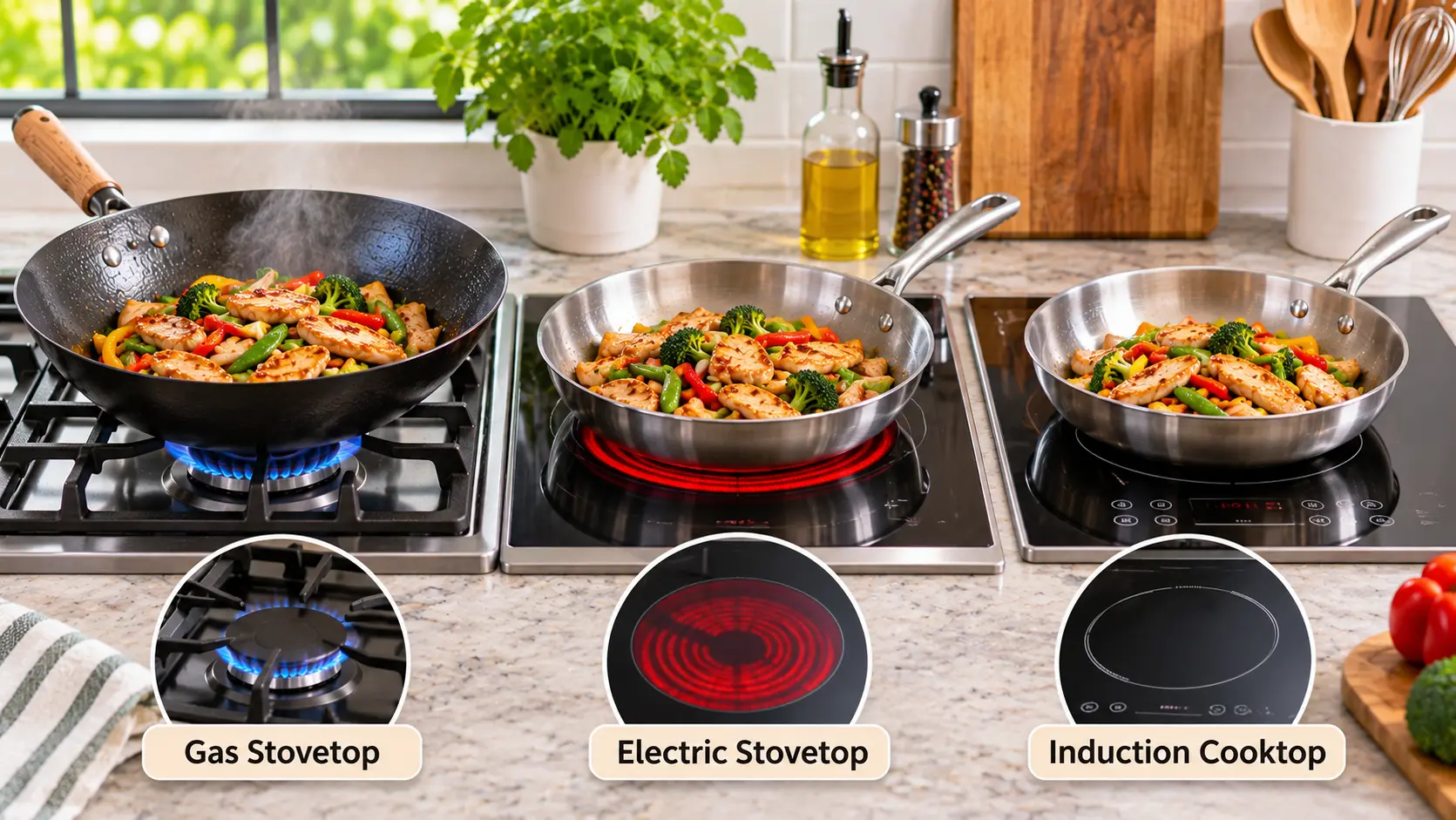
Gas Stovetops
Gas burners provide a visible flame that heats the base of the cookware. This makes them suitable for many types of frying pans and woks, provided the cookware is designed for the burner and sits securely.
A flat-bottom wok or frying pan can work well on a standard home gas stove. However, a very large pan may extend significantly beyond the area heated by the burner, creating differences in temperature across its cooking surface.
When choosing a 14-inch wok, check the burner size, flame distribution, and cookware manufacturer’s recommendations. A larger diameter does not guarantee that the entire pan will heat evenly.
Electric Coil and Smooth-Top Stovetops
Electric cooktops generally work best with cookware that has a flat, stable base appropriate for the heating element. A flat-bottom frying pan is often a convenient choice because it can maintain contact with the cooking surface.
Flat-bottom woks can also work on compatible electric cooktops, but their usable cooking area depends on the diameter of the flat base rather than the full width of the upper rim.
For a smooth glass cooktop, choose cookware with a suitable, stable base and avoid dragging rough or heavy pans across the surface. Follow the appliance manufacturer’s instructions to prevent scratching or damage.
Induction Cooktops
Induction cooktops require cookware with a magnetic base. Suitable examples include cast iron and stainless steel cookware specifically designed for induction cooking. Not every stainless steel pan is induction compatible.
You can perform a simple magnet test by placing a magnet against the bottom of the pan. If it sticks, the cookware may be suitable for induction, although you should still check the manufacturer’s compatibility information.
The base diameter is especially important. The advertised top diameter may be considerably larger than the magnetic cooking base. A large 14-inch wok with a small flat base may not work as expected if that base does not match the induction cooking zone.
If you are using an induction stove, choosing a compatible 12-inch frying pan with an appropriately sized magnetic base may be more practical than purchasing a large wok without checking its base dimensions.
How to Choose the Right Pan Size for Your Cooking Needs
Choosing the right pan does not need to be complicated. Instead of focusing only on the number printed on the packaging, consider how much chicken you usually cook, how much space the ingredients need, and whether your stovetop can heat the pan properly.
Consider Your Typical Chicken Portion
Think about your normal cooking routine. If you generally prepare one or two portions, a 10-inch or 12-inch pan may be sufficient. If you regularly cook for a family, a 12-inch or 14-inch pan may provide more flexibility.
Remember that chicken is not the only ingredient taking up space. Broccoli, carrots, bell peppers, onions, mushrooms, and sauces all contribute to the total volume of the meal.
For example, a simple chicken stir fry may fit comfortably in a 12-inch pan, while a recipe containing a large quantity of vegetables may need to be cooked in batches.
You can try our chicken stir fry recipe or chicken broccoli stir fry when planning the amount of food you want to prepare.
Measure the Usable Cooking Surface
Check the manufacturer’s product specifications before buying. Look for the flat-bottom diameter, interior dimensions, and overall pan depth.
If possible, compare the actual cooking surface rather than relying on the top rim measurement. This is especially important when comparing a conventional frying pan with a wok.
Check Burner Size and Heat Output
Make sure the pan is suitable for the heating area you intend to use. A very large pan on a small burner may not provide the cooking performance you expect.
For induction cooking, verify magnetic compatibility and the manufacturer’s recommended base dimensions. For gas and electric cooktops, consider the burner size, pan stability, and heat distribution.
Consider Weight, Handling, and Storage
A large pan may provide more cooking space, but it can also be more difficult to lift, clean, and store. This matters particularly when choosing heavy cast iron cookware or a large wok.
Consider whether you can comfortably lift the pan when it contains chicken and vegetables. Also check whether it fits in your kitchen cabinets and whether the handle requires additional storage space.
- Check the actual flat-bottom diameter.
- Choose a size that matches your usual serving quantity.
- Confirm compatibility with your stovetop.
- Consider the weight and handle design.
- Make sure you have enough storage space.
- Choose a pan that is comfortable for everyday cooking.
Which Pan Size Should You Choose? Our Recommendations
After comparing different diameters, pan shapes, materials, and stovetop requirements, the best option becomes easier to identify. The following recommendations focus on common home cooking situations rather than suggesting that one pan size is perfect for everyone.
Best Everyday Choice for Most Home Cooks
A 12-inch frying pan is a practical starting recommendation for many home cooks. It provides a useful balance between cooking space, handling, and storage. It can also be used for meals beyond chicken stir fry.
Choose a pan with a sufficiently wide flat cooking surface and construction that matches your stovetop. If you occasionally prepare larger meals, you can cook chicken in batches instead of immediately purchasing oversized cookware.
Best for Small Households
A 10-inch frying pan can be a convenient option for people who normally cook smaller portions. It takes up less storage space and is easier to handle than larger cookware.
However, if you regularly include several vegetables alongside chicken, a 12-inch pan may offer more flexibility.
Best for Family-Sized Meals
A 14-inch wok or frying pan may be worth considering for households that regularly prepare larger portions. The additional cooking space can make it easier to manage multiple ingredients.
Before buying, make sure your burner can support the pan effectively. If not, a suitable 12-inch pan with a batch-cooking approach may produce more consistent results.
Best for Frequent Wok Cooking
If you regularly prepare stir fry and enjoy tossing ingredients, a flat-bottom carbon steel wok may be a good choice. Its sloped sides provide room to move ingredients while keeping them contained.
Choose the diameter according to your cooking quantity and stovetop. For more guidance, read our article about wok vs. frying pan for stir fry.
Why Choose a 12-Inch Pan?
- Practical everyday cooking size.
- More cooking space than a 10-inch pan.
- Generally easier to handle than oversized cookware.
- Useful for different types of skillet meals.
When a 12-Inch Pan May Not Be Enough
- Preparing large family portions at once.
- Cooking bulky vegetables and chicken together.
- Preparing several servings without batch cooking.
- Recipes requiring more room for tossing ingredients.
Whichever size you choose, the cooking method matters too. If you frequently have trouble fitting all your ingredients into the pan, our guide on how to prevent overcrowding the pan when stir frying can help.
Frequently Asked Questions
What is the best pan size for chicken stir fry?
A 12-inch frying pan is a practical starting choice for many home cooks. A 10-inch pan can work for smaller portions, while a 14-inch wok or frying pan may be more suitable for larger meals when the stovetop can heat it effectively.
Is a 12-inch frying pan big enough for chicken stir fry?
Yes, a 12-inch frying pan is suitable for many everyday chicken stir fry meals. However, its actual capacity depends on the flat cooking surface, chicken quantity, vegetables, and pan construction. Larger meals may require cooking in batches.
Is a 14-inch wok too large for home cooking?
Not necessarily. A 14-inch wok can be useful for larger portions, but it needs a suitable burner and enough storage space. Check the flat-bottom diameter and your stovetop manufacturer’s recommendations before purchasing.
How much chicken can you cook in a 12-inch pan?
There is no universal chicken quantity for every 12-inch pan. The amount depends on the flat cooking surface, thickness of the chicken pieces, pan material, and heat output. Spread the pieces in a manageable layer and cook in batches if necessary.
Is a wok better than a frying pan for chicken stir fry?
A wok offers sloped sides that help with stirring and tossing, while a frying pan provides a broader flat cooking surface. Both can work well for chicken stir fry. The better option depends on your cooking technique and stovetop.
Should you cook chicken stir fry in batches?
Yes, batch cooking is useful when the pan is too crowded to spread the chicken comfortably. Cooking smaller portions helps maintain space for browning and makes it easier to manage moisture during cooking.
Does pan depth matter for stir frying?
Yes. A deeper pan or wok provides more room to move chicken and vegetables without spilling. However, depth does not replace the need for sufficient cooking surface area. Both dimensions should be considered when selecting cookware.
References
Final Thoughts
For many home cooks, a 12-inch frying pan is a sensible starting point for chicken stir fry because it balances cooking space and everyday convenience. A smaller pan can work for modest portions, while a 14-inch wok or frying pan can be useful for larger meals when the stovetop provides suitable heat.
Before choosing, consider the actual cooking surface, pan shape, material, and burner compatibility. The right pan is not necessarily the largest one. It is the one that gives your ingredients enough room to cook comfortably while remaining practical for your kitchen.
🍽️ You Might Also Like

📧 Save This Recipe For Later
Enter your email and we will send this recipe directly to your inbox.