
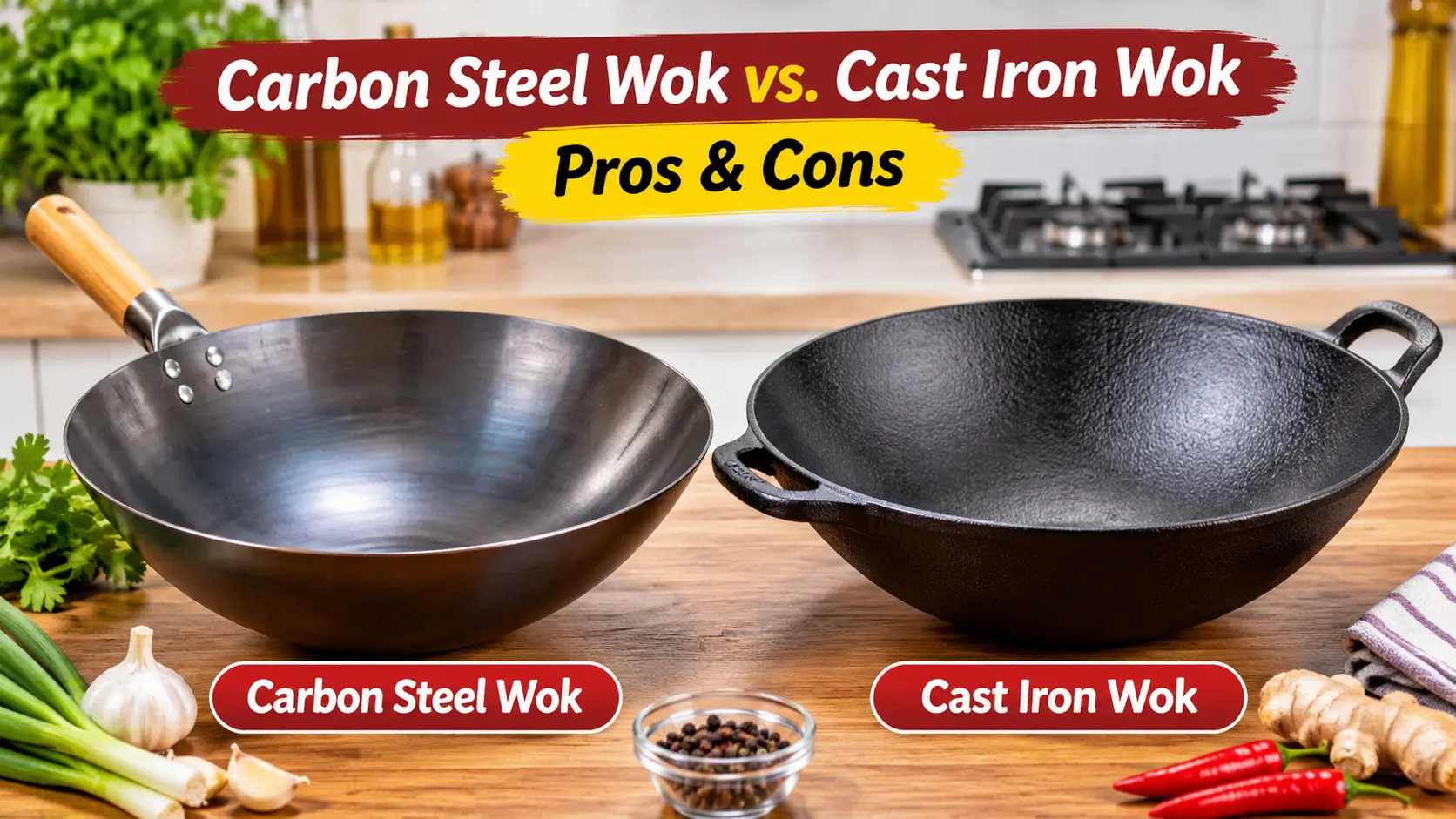
Carbon Steel Wok vs. Cast Iron Wok (Pros & Cons)
Carbon Steel Wok vs. Cast Iron Wok: Pros, Cons, and Key Differences
Choosing between a carbon steel wok and a cast iron wok can make a noticeable difference in how you prepare stir-fry at home. Both materials can handle high-heat cooking and develop a naturally seasoned cooking surface, but they differ in weight, heat response, heat retention, and everyday handling. These differences become especially important when cooking chicken, vegetables, fried rice, and other dishes that require quick temperature adjustments.
A carbon steel wok is generally lighter and easier to move, while a cast iron wok holds heat well and provides a heavier, more substantial cooking surface. However, not every cast iron wok has the same thickness or weight, so construction matters just as much as the material itself.
Understanding these differences can help you choose cookware that works with your cooking habits, kitchen equipment, and available storage space. This comparison looks at their actual cooking characteristics rather than assuming that one material is automatically better for every home cook.
Quick Answer
A carbon steel wok is generally the more practical choice for traditional stir-frying because it is lighter, easier to toss, and responds more quickly to temperature changes. A cast iron wok retains heat longer, making it useful for cooking methods that benefit from steady heat. Choose carbon steel for quick, active stir-frying and easier handling, or cast iron if heat retention is more important than weight and maneuverability.
Table of Contents
- Carbon Steel Wok vs. Cast Iron Wok: Key Differences
- Carbon Steel vs. Cast Iron Wok Comparison Table
- Heat Performance: Which Wok Heats Better?
- Stir-Frying Performance: Carbon Steel vs. Cast Iron
- Weight, Handling, and Cooking Capacity
- Stovetop Compatibility: Gas, Electric, Glass-Top, and Induction
- Seasoning, Cleaning, and Maintenance
- Durability and Long-Term Value
- Pros and Cons of Carbon Steel and Cast Iron Woks
- Which Wok Should You Choose?
- Frequently Asked Questions
- References
- Final Thoughts
1. Carbon Steel Wok vs. Cast Iron Wok: Key Differences
Carbon steel and cast iron are both iron-based cookware materials, but their manufacturing processes and physical characteristics give them different cooking properties. Understanding how each wok is constructed makes it easier to understand why one feels more responsive while the other tends to retain heat for longer.
What Is a Carbon Steel Wok?
A carbon steel wok is made from an iron and carbon alloy that is formed into a relatively thin cooking vessel. Many traditional carbon steel woks are pressed or hammered into shape, creating sloped sides that make it easier to move ingredients around the cooking surface.
One of its main advantages is its relatively low weight compared with many conventional cast iron woks. This makes it easier to lift, rotate, and toss ingredients while cooking. Its relatively quick response to changes in heat also helps cooks adjust cooking temperatures during fast stir-frying.
Carbon steel develops a seasoned surface through repeated heating and cooking with oil. With proper care, this layer helps reduce sticking and protects the underlying metal from moisture.
What Is a Cast Iron Wok?
A cast iron wok is produced by pouring molten iron into a mold and allowing it to solidify into the desired shape. This manufacturing process generally creates a thicker and heavier cooking vessel than a typical thin carbon steel wok.
Cast iron is known for its ability to retain heat once thoroughly preheated. This characteristic can help maintain a relatively stable cooking temperature when food is added to the cooking surface. It can be useful when browning ingredients or preparing foods that benefit from sustained heat.
However, cast iron woks vary considerably. Traditional Chinese cast iron woks can be thinner and lighter than the thick, heavy cast iron cookware commonly sold in American stores. Therefore, it is important to check the actual weight and construction of a particular wok rather than judging every model by the material alone.
Like carbon steel, uncoated cast iron requires seasoning and proper drying to help prevent rust and maintain its cooking surface.
How Their Construction Affects Cooking Performance
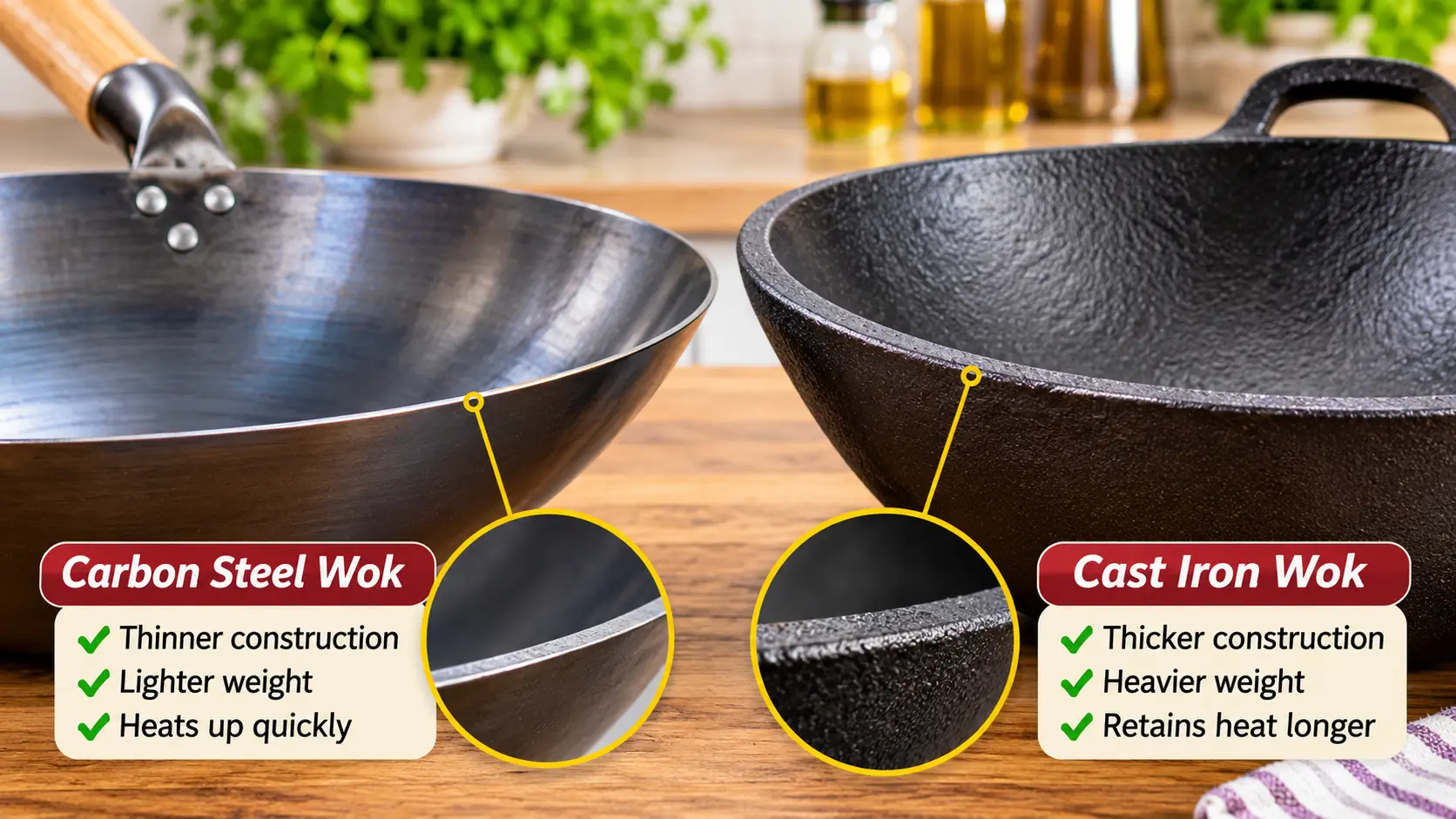
The most important difference is not simply that one wok is made from steel and the other from cast iron. Their thickness, total metal mass, shape, and surface construction all influence how they perform.
A relatively thin carbon steel wok usually heats up and responds to burner adjustments quickly. Its lighter construction also makes it easier to move ingredients around the pan.
A heavier cast iron wok generally stores more thermal energy because of its greater metal mass. This can help it maintain heat when adding a batch of cold ingredients. However, it also takes longer to respond when the cooking temperature needs to change.
These differences explain why carbon steel is commonly preferred for active stir-frying, while cast iron can be useful for cooking situations that benefit from greater heat retention.
2. Carbon Steel vs. Cast Iron Wok Comparison Table
Before examining each cooking characteristic in detail, the following table summarizes the main differences between the two wok materials. Keep in mind that actual performance depends on the thickness, weight, shape, and construction of the individual wok.
| Feature | Carbon Steel Wok | Cast Iron Wok |
|---|---|---|
| Weight | Generally lighter | Generally heavier |
| Heating response | Usually heats up quickly | Usually takes longer to heat |
| Heat retention | Generally lower | Generally higher |
| Temperature adjustment | More responsive | Less responsive |
| Food tossing | Easier to maneuver | More difficult with heavier models |
| Stir-frying | Well suited to quick stir-frying | Can handle stir-frying, depending on construction |
| Seasoning | Requires seasoning | Requires seasoning when uncoated |
| Rust prevention | Needs proper drying and care | Needs proper drying and care |
| Cleaning | Usually requires hand washing | Usually requires hand washing |
| Induction use | Compatible when the base is induction-ready | Generally compatible when the base makes suitable contact |
| Everyday handling | Often easier | Depends on the wok’s weight |
| Long-term durability | Durable with proper care | Durable with proper care |
Which Differences Matter Most for Home Cooks?
Although the comparison table includes several characteristics, four differences are especially important when choosing a wok for everyday use.
- Weight: A lighter wok is easier to lift, rotate, and toss during active cooking.
- Heat response: A responsive wok makes it easier to adjust cooking temperatures quickly.
- Heat retention: A heavier wok can maintain its temperature more effectively when adding cold ingredients.
- Stovetop compatibility: The wok’s base shape and material must work with your particular cooktop.
For example, someone who prepares chicken and vegetables in small batches may value maneuverability and temperature control more than maximum heat retention. Someone who prefers deep-frying or cooking in a heavy vessel may place greater importance on retaining heat.
3. Heat Performance: Which Wok Heats Better?
Heat performance is one of the biggest differences between carbon steel and cast iron woks. Both can withstand high cooking temperatures, but they do not respond to heat in exactly the same way.
To compare them properly, it is important to understand heating speed, heat retention, temperature responsiveness, and how each material behaves when cold food is added.
Heating Speed
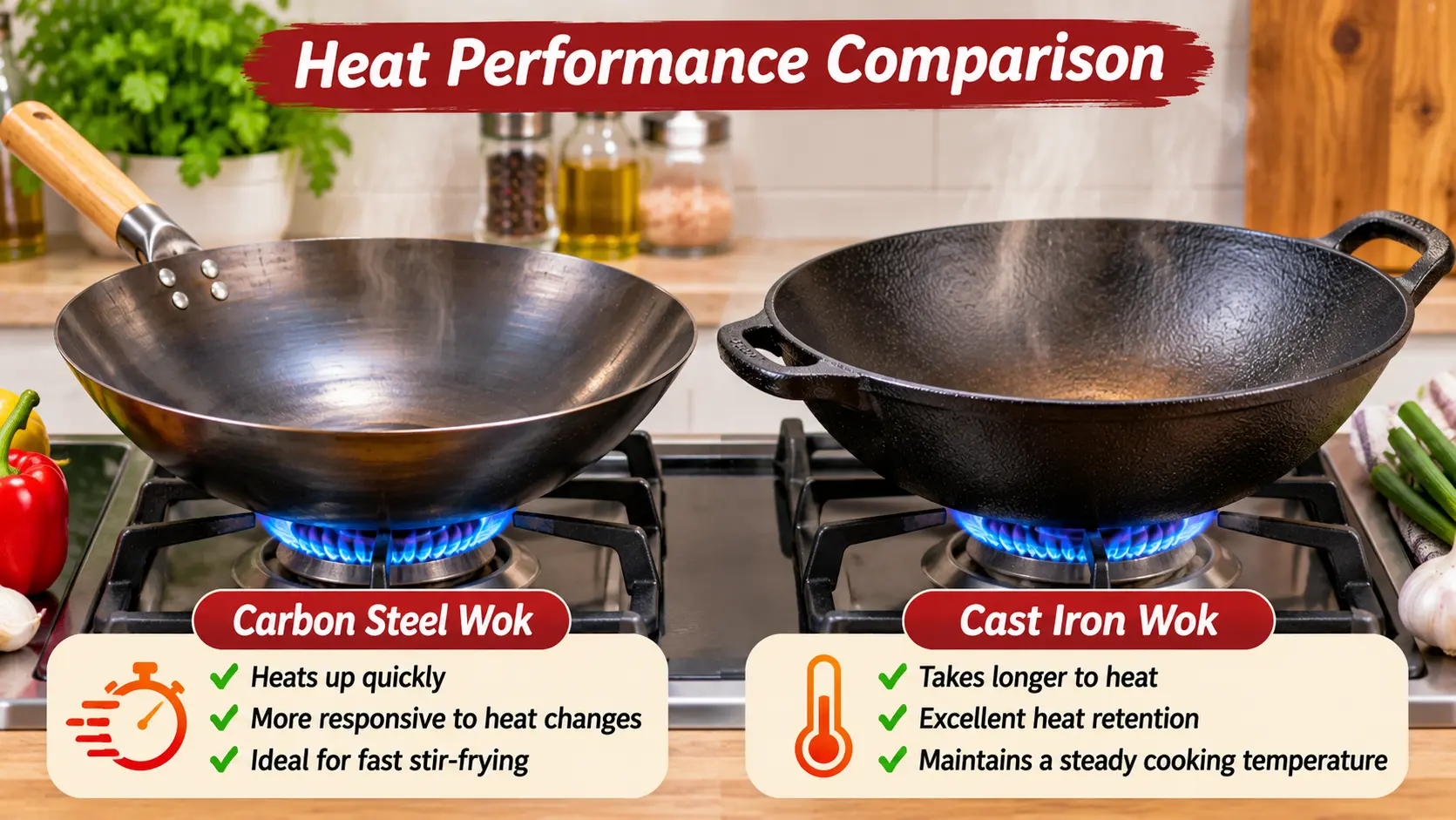
A typical thin carbon steel wok heats up relatively quickly because it contains less metal than a thick cast iron wok. This allows it to reach cooking temperature without requiring as much preheating time under comparable conditions.
A heavy cast iron wok usually needs more time to warm throughout its cooking surface. Its greater mass stores more heat, so allowing it to preheat gradually helps establish a more consistent cooking temperature.
However, the difference is not identical for every wok. A thin traditional cast iron wok may heat differently from a thick American-style cast iron model. Burner output, wok diameter, and base thickness also influence heating speed.
Heat Retention
Cast iron is particularly useful when heat retention is important. Its substantial metal mass allows it to store a considerable amount of thermal energy. This helps the cooking surface resist temperature changes when relatively cool food is added.
Carbon steel generally has less thermal mass in a typical lightweight wok. As a result, its cooking temperature may drop more noticeably when a large quantity of cold chicken or vegetables is added.
This does not automatically make cast iron better for stir-frying. A wok needs enough heat to cook ingredients properly, but it also needs to respond to changing cooking conditions. Heat retention and heat responsiveness are two different advantages.
Heat Distribution and Temperature Control
Heat distribution depends on more than the type of metal. The wok’s thickness, shape, base diameter, and contact with the burner all influence how evenly it heats.
Carbon steel is generally more responsive to changes in burner output. If you reduce the heat, a relatively thin carbon steel wok can adjust more quickly than a heavy cast iron wok.
Cast iron takes longer to respond to temperature adjustments because its greater thermal mass stores heat. This can be useful for maintaining a steady cooking temperature, but it requires more planning when moving between high-heat searing and lower-temperature cooking.
Neither material guarantees perfectly even heating across every part of the wok. The center may become hotter than the sloping sides, particularly on a conventional flat electric or induction cooking surface.
What Happens When Cold Food Is Added?
Adding cold ingredients to a hot wok reduces the cooking surface temperature. The size of that temperature change depends on the quantity and temperature of the ingredients, the wok’s stored heat, and the power of the burner.
A heavier cast iron wok may experience a smaller temperature drop because it stores more thermal energy. A lightweight carbon steel wok may lose temperature more noticeably when overloaded with food.
However, a strong burner and sensible batch sizes are important for both materials. Even a heavy cast iron wok cannot compensate for an underpowered burner or an overcrowded cooking surface.
4. Stir-Frying Performance: Carbon Steel vs. Cast Iron
Stir-frying requires more than a wok that can reach a high temperature. The cookware must also allow ingredients to move easily, respond to changing heat levels, and provide enough cooking space to prevent food from becoming overcrowded.
Both carbon steel and cast iron woks can prepare stir-fried meals, but their weight and thermal characteristics create different cooking experiences. For most traditional stir-frying techniques, a lightweight carbon steel wok is easier to maneuver. A cast iron wok can also produce good results, particularly when its construction is relatively thin and the cook adjusts the batch size and cooking temperature appropriately.
Cooking Chicken and Other Proteins
Chicken stir-fry often involves cooking thinly sliced chicken breast or thighs over relatively high heat. The goal is to brown the outside while keeping the inside properly cooked without allowing excess moisture to collect in the wok.
A carbon steel wok makes it easier to move chicken pieces around the cooking surface. Its responsive heating characteristics also help when adjusting the burner as the chicken begins to release moisture. This is particularly useful when cooking several small batches.
A cast iron wok can also brown chicken effectively because it retains heat well. This can be helpful when adding a batch of ingredients to a properly preheated cooking surface. However, a heavy cast iron wok is harder to lift and move, and its retained heat makes temperature adjustments slower.
For a practical example, consider preparing chicken for a homemade chicken stir-fry. A carbon steel wok allows the cook to move the chicken around easily while preparing the sauce and adding vegetables. A cast iron wok can perform the same task, but it may be more comfortable to leave it on the burner and stir with a wok spatula rather than repeatedly lifting it.
Stir-Frying Vegetables
Vegetables such as broccoli, bell peppers, carrots, cabbage, and snap peas benefit from relatively quick cooking. They need enough heat to develop flavor while retaining some of their natural texture.
Carbon steel is convenient for this type of cooking because its lighter construction makes it easier to lift, tilt, and toss vegetables. Its faster response to burner adjustments also gives the cook greater flexibility when moving between different cooking stages.
Cast iron can cook vegetables successfully, but its heavier construction may make frequent tossing difficult. Its heat retention can also continue cooking ingredients after the burner is reduced, so timing becomes particularly important.
When preparing a chicken and broccoli stir-fry, for example, broccoli may need a brief period of steaming or a small amount of added water before the final stir-frying stage. Both wok materials can handle this process, although carbon steel is generally easier to maneuver during quick ingredient transitions.
Searing and Browning Food
Both materials can brown meat when they are properly preheated and used with suitable cooking techniques. The difference is how they manage stored heat and how easily the cook can control the cooking process.
A cast iron wok’s greater thermal mass can help maintain a hot cooking surface when ingredients are added. This can be useful for browning larger or colder pieces of food, provided the wok is sufficiently preheated.
A carbon steel wok can also produce effective browning, especially when it is heated properly and the ingredients are not overcrowded. Its lighter construction makes it easier to move food between the center and sloping sides of the wok.
Neither material guarantees better browning in every situation. Burner strength, preheating time, food moisture, surface condition, and cooking quantity all affect the result.
Cooking in Small Batches
Batch cooking is important when preparing stir-fry at home because residential stovetops generally provide less concentrated heat than commercial wok burners.
Instead of adding all the chicken and vegetables at once, cook the protein first, remove it temporarily, prepare the vegetables, and combine everything with the sauce near the end. This helps prevent the ingredients from releasing more moisture than the wok can evaporate efficiently.
Carbon steel is particularly convenient for this process because it is easier to move and responds relatively quickly when the heat is adjusted between batches.
A cast iron wok can also handle batch cooking effectively. Its heat retention may be helpful when adding ingredients, but the cook should monitor the temperature carefully because the heavy cooking surface takes longer to cool.
Which Wok Is Better for Traditional Stir-Frying?
For traditional stir-frying that involves frequent tossing, rapid ingredient movement, and changing heat levels, carbon steel is generally the more practical choice. Its lighter weight and responsive heating make it easier to perform these techniques.
However, this does not mean cast iron cannot produce excellent stir-fried food. A thinner traditional Chinese cast iron wok can be easier to handle than a heavy cast iron model commonly sold in American cookware stores.
The distinction between thin Chinese-style cast iron and thick American-style cast iron is important. Buyers should evaluate the actual wok rather than assuming that all cast iron cookware has the same weight or performance.
5. Weight, Handling, and Cooking Capacity
A wok should be comfortable to use, particularly when preparing meals that require repeated stirring, lifting, and moving ingredients. Weight and overall design can influence how easily you control the cooking process.
Which Wok Is Easier to Lift and Toss?
Carbon steel woks are generally lighter than conventional heavy cast iron woks. This makes them easier to lift, tilt, rotate, and toss during active cooking.
Food tossing is one of the familiar techniques associated with wok cooking. The cook briefly lifts and moves the wok so that ingredients travel up the sloped sides and return toward the center. A lighter wok makes this movement easier to learn and repeat.
Cast iron woks are generally more difficult to toss when they are made with thick, heavy construction. Their weight becomes even more noticeable after adding chicken, vegetables, noodles, or other ingredients.
However, not all cast iron woks are equally heavy. Traditional thin Chinese cast iron models can be considerably lighter than thick cast iron models designed for American home kitchens.
Does Wok Weight Affect Everyday Cooking?
Weight matters most when you regularly move the cookware during preparation. If you prefer to toss ingredients directly in the wok, a lightweight carbon steel model is often more comfortable.
If you usually keep the wok stationary and use a spatula to stir ingredients, the additional weight of cast iron may be less of a disadvantage.
Storage and cleaning also deserve consideration. A heavy wok can be more difficult to lift into a cabinet, carry to the sink, and wash safely. This can become inconvenient for people with limited storage space or reduced lifting strength.
Wok Size, Cooking Surface, and Food Overcrowding
Wok diameter affects how much food you can prepare comfortably, but a larger wok does not automatically produce better stir-frying results.
A wider cooking vessel provides more room to spread ingredients and move them around. However, it also needs enough burner power to heat the cooking surface effectively.
For many home kitchens, a 14-inch wok is a practical size. It provides useful cooking space for everyday meals without being excessively large for many residential stovetops.
A smaller wok may be more appropriate for one or two servings, while a larger household may benefit from a bigger cooking surface if the stove can support it.
The material also affects the experience. A large carbon steel wok may still be relatively manageable, whereas a large, thick cast iron wok can become difficult to lift when full.
Regardless of material, avoid filling the wok beyond its practical cooking capacity. Overcrowding traps moisture and can cause ingredients to steam instead of browning properly.
6. Stovetop Compatibility: Gas, Electric, Glass-Top, and Induction
Your stovetop is an important factor when choosing between a carbon steel wok and a cast iron wok. Even a well-constructed wok may perform poorly if its base does not make suitable contact with the heat source.
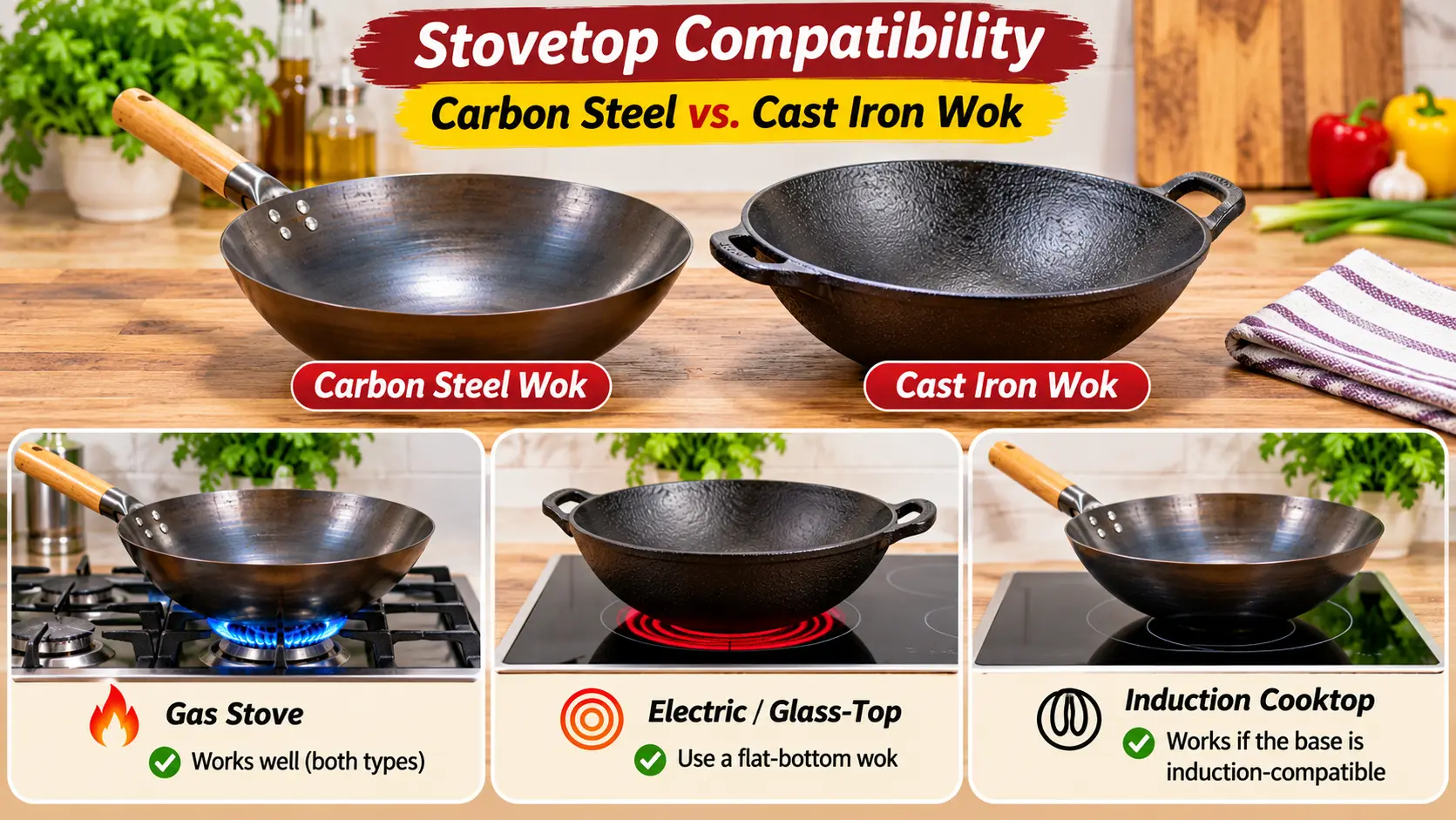
Traditional round-bottom woks are designed for burners that support their curved shape. Most residential American kitchens use flat cooking surfaces, so flat-bottom woks are often more convenient.
Carbon Steel vs. Cast Iron on Gas Stoves
Gas stoves are generally well suited to wok cooking because the flame can heat the bottom and, depending on the burner design, parts of the sloped sides.
Carbon steel woks are particularly convenient on gas stoves because they are lightweight and respond quickly to adjustments in burner output. A flat-bottom model can sit securely on many standard residential gas ranges.
Cast iron woks can also work well on gas burners. Their heavier construction helps them remain stable, but they generally need more time to preheat. A suitable burner grate or wok support is important for keeping the cooking vessel properly positioned.
If you have a high-output gas burner or a dedicated wok burner, you may have more flexibility when choosing between flat-bottom and round-bottom designs.
Using Both Woks on Electric and Glass-Top Stoves
Electric coil and glass-top electric stoves usually work best with flat-bottom woks designed for residential cooking surfaces.
A flat base provides more consistent contact with the heating element or glass cooking surface. A round-bottom wok may not sit securely on these surfaces without a suitable support, and a wok ring can reduce direct contact with the heat source.
Carbon steel woks are available in flat-bottom designs that work with many electric cooktops. Their lighter construction also makes them easier to reposition when necessary.
Cast iron woks with flat bases can also be used on compatible electric stoves. However, their weight requires extra care on glass-top surfaces.
Always lift cast iron cookware rather than dragging it across a glass cooktop. Check your cooktop manufacturer’s instructions regarding cookware weight and recommended base construction.
Which Wok Works Better on Induction?
Induction cooktops heat compatible cookware through a magnetic field. Therefore, the wok must have a suitable magnetic base and sufficient contact with the induction cooking zone.
Cast iron is naturally magnetic, so many cast iron woks are compatible with induction cooktops. However, a round-bottom wok may not work properly on a standard flat induction surface because its base cannot make suitable contact with the cooking zone.
Carbon steel is also magnetic and can work with induction. However, buyers should check the manufacturer’s induction compatibility information because wok construction, base shape, and the size of the cooking surface can affect performance.
A flat-bottom carbon steel wok specifically designed for induction is often a practical option for home kitchens.
Flat-Bottom vs. Round-Bottom Woks
The shape of the wok’s bottom is just as important as the material when selecting cookware for a home kitchen.
A flat-bottom wok is designed to sit directly on a flat cooking surface. It is generally easier to use on standard gas ranges, electric coil stoves, glass-top cooktops, and compatible induction units.
A round-bottom wok is traditionally used with a wok ring or a burner specifically designed to support its curved shape. This design allows the cooking vessel to sit naturally over a concentrated heat source.
For most residential kitchens, a flat-bottom wok is the more convenient option. If you have a dedicated wok burner or a compatible gas range, a round-bottom design may also be suitable.
7. Seasoning, Cleaning, and Maintenance
Both carbon steel and uncoated cast iron woks require proper care to maintain their cooking surfaces and reduce the risk of rust. Unlike stainless steel cookware, these materials benefit from a layer of seasoning that develops through heating oil on the metal surface.
Although their maintenance routines are similar, the thickness and construction of each wok can influence how easily it is cleaned, dried, and handled after cooking.
Seasoning a Carbon Steel Wok
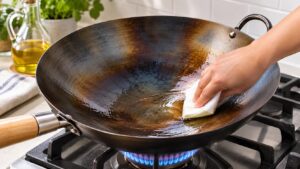
Seasoning a carbon steel wok involves creating a thin protective layer of polymerized oil on its cooking surface. This layer helps protect the underlying steel from moisture and gradually improves food release as the wok is used.
Most unseasoned carbon steel woks should be cleaned before their first use to remove any protective manufacturing or shipping residue. Follow the manufacturer’s instructions because some models arrive pre-seasoned while others require complete initial seasoning.
For a typical unseasoned carbon steel wok, the process involves:
- Wash the wok with warm water and mild dish detergent to remove manufacturing residue.
- Rinse thoroughly and dry the entire surface.
- Apply a very thin, even layer of suitable cooking oil.
- Heat the wok according to the manufacturer’s seasoning instructions.
- Allow it to cool safely and wipe away any excess oil.
- Repeat the seasoning process if required by the manufacturer.
With regular cooking and appropriate maintenance, the surface gradually develops a darker patina. This is a normal characteristic of seasoned carbon steel cookware.
If you want more detailed instructions, see our guide on how to season a carbon steel wok.
Seasoning a Cast Iron Wok
Uncoated cast iron woks also benefit from seasoning. The process creates a protective cooking surface that helps reduce sticking and limits direct exposure of the iron to moisture.
Before seasoning a new cast iron wok, check whether it comes pre-seasoned. Some manufacturers apply a protective coating during production, while others provide cookware that needs seasoning before its first cooking session.
For an unseasoned model, the general process is similar to carbon steel:
- Wash the wok according to its manufacturer’s initial-use instructions.
- Dry it thoroughly, including the bottom and exterior surfaces.
- Apply a thin coating of suitable cooking oil.
- Heat the wok using the recommended seasoning method.
- Allow it to cool and remove any visible excess oil.
- Repeat if necessary to establish a more consistent protective surface.
Cast iron can gradually develop a dark, seasoned patina through repeated cooking and maintenance. However, seasoning does not make the cookware identical to a modern synthetic nonstick pan. Some cooking oil and appropriate preheating may still be necessary to prevent food from sticking.
The main practical difference is that a thick cast iron wok can take longer to heat and cool during seasoning and maintenance. Its weight may also make it less convenient to rotate when applying oil to the entire cooking surface.
Cleaning and Drying Both Materials
Neither carbon steel nor uncoated cast iron should be treated like ordinary dishwasher-safe cookware. Prolonged exposure to water and aggressive cleaning can damage seasoning and increase the risk of rust.
For routine cleaning, follow these steps:
- Allow the wok to cool enough to handle safely.
- Remove leftover food and cooking residue.
- Wash with warm water and a suitable soft sponge or brush.
- Use a small amount of mild dish detergent when necessary for grease or stubborn residue, following the manufacturer’s instructions.
- Rinse thoroughly and dry immediately with a clean towel.
- Use gentle stovetop heat if needed to remove remaining moisture.
- Apply a very thin layer of cooking oil if recommended for the cookware.
Avoid leaving either wok soaking in the sink. Water sitting against unprotected iron or steel can encourage rust, especially where the seasoning has worn away.
Carbon steel is generally easier to lift and position over the sink because it is lighter. A heavy cast iron wok can require more effort, particularly when washing a large model.
For additional cleaning instructions, see our guide on how to clean and maintain a carbon steel wok.
Preventing Rust and Maintaining the Cooking Surface
Both carbon steel and uncoated cast iron can rust when exposed to moisture for extended periods. Their seasoning layers help protect the metal, but damaged or uneven areas may still require attention.
To reduce the risk of rust:
- Dry the wok thoroughly after every wash.
- Avoid storing it while damp.
- Apply a very thin layer of oil when appropriate.
- Store the wok in a dry location with adequate airflow.
- Re-season areas where the protective cooking surface has deteriorated.
- Avoid prolonged exposure to acidic ingredients when the seasoning is still developing.
Foods containing tomatoes, vinegar, citrus juice, and other acidic ingredients can gradually affect seasoning when cooked for extended periods. Brief use of acidic ingredients is not necessarily a problem, but prolonged simmering in an uncoated seasoned wok can weaken its protective layer.
If rust develops, it does not automatically mean the wok must be replaced. The affected area may be cleaned and re-seasoned, provided the cookware itself is not structurally damaged. Follow the manufacturer’s restoration instructions.
8. Durability and Long-Term Value
Carbon steel and cast iron woks can both provide years of use when properly maintained. Neither material should automatically be considered more durable in every situation because thickness, manufacturing quality, construction, and handling all influence its lifespan.
Which Wok Lasts Longer?
A well-made carbon steel wok can last for many years because its cooking surface can be re-seasoned when necessary. Even if the patina becomes uneven or some rust develops, the surface can often be restored through appropriate cleaning and seasoning.
Cast iron is also known for its long-term durability. Its substantial construction can withstand regular cooking, and its seasoned surface can be maintained or rebuilt over time.
However, cast iron is not indestructible. Severe thermal shock, accidental drops, or physical impacts can damage or crack certain cast iron cookware. Its heavier construction also requires careful handling.
Rather than choosing solely based on the material, consider the manufacturer’s construction quality, warranty, thickness, and recommended care practices.
Resistance to Warping, Damage, and Rust
Carbon steel and cast iron behave differently when exposed to sudden temperature changes and physical stress.
Thinner carbon steel cookware may be more susceptible to warping when exposed to excessive or uneven heating, particularly if the metal is very thin. The risk depends on the design, thickness, and manufacturing quality.
Cast iron generally has a rigid, substantial construction, but it can crack if dropped or exposed to severe thermal shock. A hot cast iron wok should not be placed directly into cold water.
Both materials can rust when their protective seasoning is damaged or the cookware is stored while wet. Neither should be left soaking in water for extended periods.
Maintenance Costs and Long-Term Ownership
Both materials can offer good long-term value because seasoning can be maintained without relying on a disposable nonstick coating. However, their overall ownership experience depends on how often you cook and how much maintenance you are willing to perform.
Carbon steel may be more convenient for someone who regularly prepares stir-fries and wants cookware that is relatively easy to move, wash, and store.
Cast iron may be appealing to someone who prefers heavier cookware and values its ability to retain heat. However, its weight can make daily cleaning and storage less convenient.
Both require some attention to prevent rust and maintain seasoning. Neither should be considered completely maintenance-free.
9. Pros and Cons of Carbon Steel and Cast Iron Woks
After comparing their construction, cooking performance, heat characteristics, and maintenance requirements, the advantages and disadvantages become easier to identify.
Carbon Steel Wok: Pros and Cons
Pros
- Generally lighter than conventional heavy cast iron woks.
- Easier to lift, toss, and maneuver during stir-frying.
- Usually responds quickly to changes in burner temperature.
- Heats up relatively quickly when made with thin construction.
- Develops a seasoned cooking surface through regular use.
- Suitable for a wide range of stir-frying techniques.
- Available in flat-bottom designs for many home stovetops.
Cons
- Generally retains less heat than thick cast iron cookware.
- Temperature may drop noticeably when the wok is overcrowded.
- Requires seasoning and proper drying.
- Can rust if stored while wet.
- Very thin models may be more susceptible to warping.
- Seasoning can be affected by prolonged cooking with acidic ingredients.
Cast Iron Wok: Pros and Cons
Pros
- Excellent heat retention, especially in heavier models.
- Can maintain cooking temperature when adding ingredients.
- Suitable for searing, browning, and other high-heat cooking methods.
- Can develop a durable seasoned cooking surface.
- Long-lasting when properly maintained.
- Available in different designs, including traditional Chinese-style woks.
Cons
- Many conventional models are considerably heavier.
- More difficult to lift and toss during active cooking.
- Generally takes longer to heat and cool.
- Less responsive to rapid temperature adjustments.
- Requires careful handling, especially on glass-top cooktops.
- Needs proper drying and maintenance to prevent rust.
The most important distinction is how these advantages fit your cooking routine. Carbon steel offers greater convenience for frequent movement and temperature adjustments, while cast iron offers greater heat retention in heavier constructions.
For someone who mainly prepares quick chicken and vegetable stir-fries, the lighter handling of carbon steel may be more useful. For someone who prefers a heavy cooking vessel and values retained heat, cast iron may be a suitable alternative.
10. Which Wok Should You Choose?
The best wok for your kitchen depends on how you cook, how much weight you are comfortable handling, and which stovetop you use. Carbon steel and cast iron can both prepare excellent meals, but their different characteristics make them suitable for different cooking preferences.
Rather than choosing based on material alone, consider how often you stir-fry, whether you prefer tossing ingredients, and how much maintenance you are willing to perform.
Best for Everyday Home Stir-Frying
A carbon steel wok is generally a practical choice for everyday home stir-frying. Its lighter construction makes it easier to move ingredients, while its responsive heating characteristics help when adjusting cooking temperatures.
This is especially useful when preparing meals that involve several cooking stages, such as browning chicken, cooking vegetables, and combining everything with a sauce.
If you regularly prepare meals such as chicken stir-fry or garlic chicken stir-fry, a carbon steel wok can make everyday cooking more manageable.
Best for Beginners
For many beginners, a flat-bottom carbon steel wok is a convenient starting point. It is generally easier to lift and maneuver than a heavy cast iron wok, particularly when learning how to stir, turn, and toss ingredients.
However, beginners should understand that carbon steel requires proper preheating, seasoning, and moisture control. Food may stick if the cooking surface is not properly prepared or the wok is not sufficiently heated.
A beginner who prefers a stationary cooking vessel and does not intend to toss ingredients may also be comfortable using a cast iron wok. The actual weight should be checked before purchasing.
Best for Heavy-Duty Cooking and Heat Retention
A cast iron wok may suit cooks who prioritize heat retention and prefer heavier cookware. Its substantial metal mass can help maintain cooking temperatures when adding ingredients.
It can be useful for browning, searing, and cooking methods where a stable cooking temperature is desirable. However, a thick cast iron wok is not necessarily the easiest option for fast stir-frying that involves frequent tossing and rapid temperature changes.
Consider the actual construction of the wok before buying. A traditional thin cast iron wok can offer a different handling experience from a thick, heavy cast iron model.
Best for Induction and Electric Stovetops
For induction and flat electric cooktops, the most important consideration is the wok’s base design and compatibility with the cooking surface.
A flat-bottom carbon steel wok specifically designed for induction can be a practical choice because it combines a relatively lightweight construction with a magnetic cooking surface.
A compatible flat-bottom cast iron wok can also work on induction and electric cooktops. However, its weight requires extra care when handling it on glass surfaces.
Before purchasing either material, check the manufacturer’s compatibility information and the minimum cookware requirements of your cooktop.
Best for People Who Prefer Lightweight Cookware
Carbon steel is generally the more suitable option for people who prefer lightweight cookware. It is easier to lift, clean, reposition, and store than many conventional heavy cast iron woks.
This can be particularly helpful when cooking regularly or preparing meals that require repeated movement of the cooking vessel.
However, people who prefer using a spatula instead of tossing ingredients may not consider weight as important. In that situation, a cast iron wok may still be a reasonable choice.
Frequently Asked Questions
Is carbon steel better than cast iron for stir-frying?
Carbon steel is generally more convenient for traditional stir-frying because it is lighter and responds more quickly to temperature changes. This makes tossing ingredients and adjusting cooking heat easier. Cast iron can also produce good stir-fry results, particularly when using a thinner wok or cooking without frequent tossing.
Does a cast iron wok take longer to heat up?
A thick, heavy cast iron wok generally takes longer to heat than a typical thin carbon steel wok because it contains more metal. However, heating time depends on the wok’s thickness, size, construction, and burner output. Thin traditional cast iron woks may behave differently from heavier models.
Can you use a cast iron wok on an induction cooktop?
Yes. Cast iron is magnetic and is generally compatible with induction cooking. However, a flat-bottom design that makes suitable contact with the induction surface is important. Check the cookware and cooktop manufacturers’ instructions before use.
Which wok is easier to season?
Both carbon steel and uncoated cast iron require similar seasoning principles: clean the surface, apply a very thin layer of suitable cooking oil, and heat it according to the manufacturer’s instructions. The practical process is similar, although the weight and thickness of a particular wok can affect handling.
Does a carbon steel wok rust easily?
Carbon steel can rust if it remains wet or is stored in a damp environment. However, regular seasoning, thorough drying, and proper storage help protect its surface. Cast iron also requires similar moisture protection, so neither material should be left soaking in water.
Is a cast iron wok too heavy for everyday cooking?
Not necessarily. Some people are comfortable using a heavy cast iron wok every day, especially when they prefer stationary cooking with a spatula. However, thicker models can be difficult to lift, toss, and wash. Checking the actual weight before purchasing is the best way to determine whether it suits your needs.
Can both types of woks be used for chicken stir-fry?
Yes. Both carbon steel and cast iron woks can cook chicken stir-fry. Carbon steel is generally easier to maneuver during quick cooking, while cast iron can retain heat effectively when properly preheated. For either material, cooking chicken in manageable batches helps prevent overcrowding and excessive moisture buildup.
References
Final Thoughts
Carbon steel and cast iron woks both have useful qualities, but they offer different cooking experiences. Carbon steel is generally lighter, easier to maneuver, and more responsive to temperature changes, making it a practical option for frequent stir-frying. Cast iron offers greater heat retention in heavier constructions and can be useful for cooks who prefer a substantial cooking surface.
For most home cooks who regularly prepare chicken, vegetables, and quick stir-fry meals, a flat-bottom carbon steel wok is a sensible starting point. However, a cast iron wok can still be a suitable choice if you value heat retention and do not mind the additional weight.
Ultimately, the right wok is the one that matches your cooking habits, stovetop, and maintenance preferences. Consider these factors together rather than choosing based on material alone.
🍽️ You Might Also Like

📧 Save This Recipe For Later
Enter your email and we will send this recipe directly to your inbox.